In The Principles of Scientific Management published in 1911, Taylor explained that workers should be individually monitored. He added that the “system of management” should measure their performance in order to increase the overall output of the factory. The white-collar was the only “competent man,” and he was responsible for defining the best way to “eliminate every unnecessary movement” and then increase individual efficiency. It was a revolution for the time, and it strongly improved both the US’ and Europe’s production.

More than 100 years later, the job of the average Joe is profoundly different, even in automotive factories. Most of the jobs now require teamwork and collaboration, and knowledge workers count at least 230 million people (or even 1 billion). Managers are not the only “competent” people in the room anymore and are even encouraged to take a step back of delivery activities and let their team self-organize.
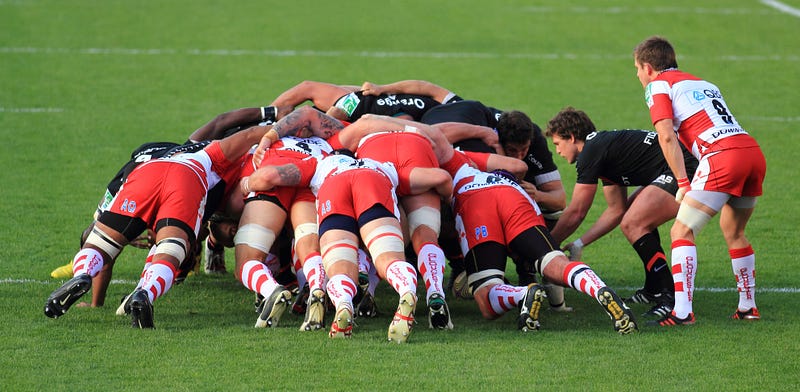
We will focus more specifically in this article on agile team. For example, Scrum, the most popular Agile Framework, advises Scrum teams to define collective objectives (sprint backlog) and to share accountability for their success and failures as a group (sprint review and retrospective). The individual should serve the group, and the group should serve a higher purpose: the customer. This relates to the “no hero” mindset, aka, “scrum” in rugby.
However, most HR processes have not evolved yet and are still organized to motivate and guide employees toward individual goals.
Should we keep evaluating individual contributions or should we start evaluating group performance?
Are these performance evaluations still relevant for knowledge workers?
Should we even keep evaluating people?
Issues with Individual Performance evaluation
Heavy performance management systems are usually set in place to identify individual performance and then reward them accordingly. Every year, managers sit with their staff and evaluate them based on the objectives defined the previous year. In Scrum, teams are self-organized which leads to the following limitations:
- The team manager is not part of the team and has a limited visibility on individual interactions and activities
- Yearly evaluations are completely disconnected from operational realities and team continuous improvement cycles (during sprint retrospectives)
- It is very difficult to define and then measure the individual contribution of a collaborator in a team (see following section)
- When a single person is responsible for the performance evaluation, studies show that the rating reflect 60% of the rater rather than the ratee. It is called the “idiosyncratic rater effect”.
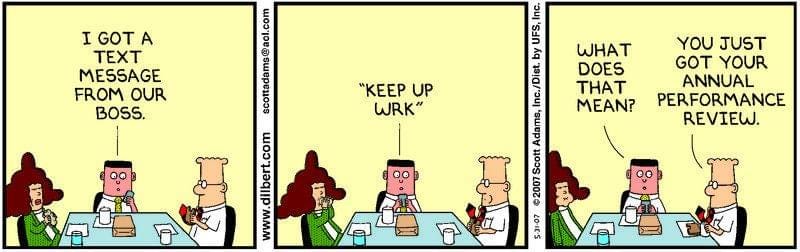
As a result, these evaluation campaigns are often perceived by managers as difficult and painful. Evaluated staff may feel that their managers are not really grateful for their contribution and that these yearly evaluations are useless.
Another fundamental drawback is the inconsistency between team objectives and individual objectives. Rewarding individual performance while pushing collaboration and team spirit create major dissonances. Should I consistently spend time helping my coworker if in the end it will prevent me from reaching my own objectives? This double speak may have a strong impact in team member cohesiveness and collaboration.
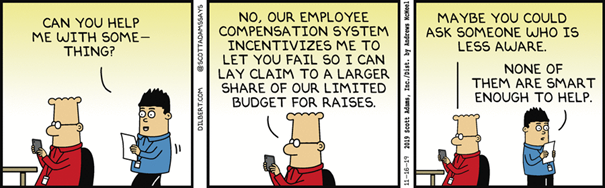
When this type of individual evaluation is not working, should the company switch to team-based performance evaluation?
Issues with Team Performance evaluation
In a Scrum context, objectives are set at the beginning of every sprint, and the team can measure its velocity and predictability regarding these objectives at the end of the sprint. When each collaborator feels accountable for the team performance, these recurring evaluations foster teamwork and collaboration.
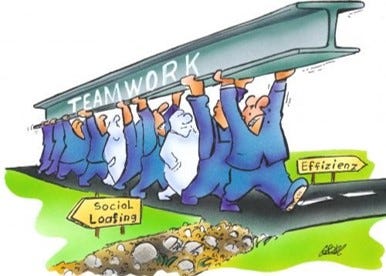
However, when the team is less cohesive, and the work organization is less transparent, social loafing might appear: some individuals may contribute less to team effort than they would if they were solely charged with the responsibility.
Levi-Strauss run the experiment in the ’90s: they switched from an individual output-based compensation system to a team-based compensation one. Teams were created, and Levi-Strauss started paying workers according to the number of pairs of jeans the entire team was able to produce. After a couple of months, sheriff’s deputies were added at the entrance to the plant as workers were heavily bullying each other. Some of them figured out that they could slow down a little while keeping the paychecks, and the others did not accept this unfairness. This example highlights that team-based performance evaluation is doomed without cohesiveness and shared accountability.
At this point, depending on the context we have seen that both individual and team-based performance evaluation can have side effects that exceed the expected benefits. One might ask why we keep evaluating performance…
Why evaluating performance is necessary
Performance evaluation is not bad, as it provides valuable feedback on an individual/team performance. How can someone know if she runs fast or not without measuring the time needed to run 100 meters? How can she improve without a detailed evaluation of her race, her strengths, her weaknesses? Even at school, children performance is measured and shared, and these evaluations help them to improve over time.
Measuring performance is the best way to improve individual and team performance.
However, its translation into the working world faces 3 major challenges:
The Why — The first one is that most companies lost the original purpose of performance evaluation. They link performance evaluations to financial compensations because they believe that rewarding good performance will lead to an increase in team/individual performance. Daniel Pink discussed in detail this assumption in his latest book and concluded that this carrot and stick approach is outdated and inefficient for non-deterministic work.
The How — The second issue is the difficulty to link individual contributions and team performance, especially for knowledge workers working in teams:
-
Team performance is often not obvious: being compliant to deadlines? The quality of deliveries? The generated value? The customer satisfaction? The team well-being?
-
How to characterize individual contribution and measure it objectively?
The What — The last issue comes from the notion of benchmark in the performance evaluation. It implies that everyone can be compared to a norm and their actions/practices analyzed accordingly. In reality, everyone brings something different to the team and there is more value in the interactions between team members than the sum of their individual skills.
For example, in a soccer team, most goals are scored by the strikers, but it doesn’t mean that the defenders are useless. And the best soccer team are the most cohesive and supportive ones, not the teams with the best individuals. In a greater extent a scrum team follows the same patterns as a sport team. Everyone brings specific technical and analytic skills and being too normative reduce team diversity, then efficiency and overall performance.
With these challenges, we understand why managers should not remain the only ones who measure individual performance and why we need to think to other options to keep evaluating performance.

The performance evaluation itself should not be thrown away but we need to rethink how performance is evaluated and how the results are used.
Peer review evaluation is one solution
How to reconcile the need for performance evaluation and the operational side effect mentioned earlier?
One clever solution is using peer-review to get a more accurate measure of individual performance. Using peer feedback to evaluate individual performance is not new, but it becomes much more useful and meaningful in an Agile context as the team is self-organized. The real challenge is how to design an efficient peer review system that fosters both individual and team performance.
A key learning comes from Daniel Gu at eBay, where he put in place such a peer feedback system: an anonymous survey is sent monthly to every team member to evaluate every other team members. This high frequency enables the team to monitor progress as well as not fall into the “most recent performance counting” trap. The survey covers the following area:
- Communication
- Work Quality
- Collaboration
- Continuous Improvement
- Role Sharing and sense of Responsibility
- Energizing
- Overall Satisfaction
One factor of success for this system at eBay is creating a safe environment where team members can express themselves without pressure from their management or coworkers. After several months of using this peer feedback mechanism at eBay, teams and team members were able to see their strengths and weaknesses and follow their progress. What was intended to be a “management tool” has become a valuable input for team retrospective meetings and has definitively improved the quality of team deliveries.
With this system, Daniel Gu acknowledges that there is not a single way to measure objectively individual performance. He believes that the closer we can get to the true contribution of an individual is to gather the subjective perception of all his/her co-worker. Unfortunately, other bias may then appear: popularity bias, halo effect…
As a summary
Defining and measuring the performance of knowledge workers is always difficult. Whatever the selected option to evaluate the performance of your staff, start by creating a safe environment to enable regular and frank feedback.
Then collectively define what individual and team “performance” mean in your context.
Only then define which performance management option is the most relevant for you.