A few months ago, I presented Agile methodologies to financial auditors. The objective was to demonstrate why agile is relevant to their activities and to push them to rethink their work with agile principles in mind. It was much more difficult than expected.
As always when giving this presentation, the first step was to highlight the recurring problems within traditional project management: tunnel effect, delays, cost slippage… However this time, I was surprised to discover that “project” didn’t have the same meaning in the audit sector. Most of the time, auditors follow pre-designed and optimized processes to deliver standardized documents at a fixed date with no or very little admissible delays.

In industries or IT departments, a project consist usually in building something new for a customer (internal or external), where the exact content of the delivered item can never be fully specified and stable throughout the project duration. The scope of a project is regularly updated due to changes in customer needs/priorities, or to hidden complexities discovered by the project team.
Therefore, my “bad project management” statements didn’t echo with their own experience: I was on the wrong track with the “start with why” approach.
Obviously, the rest of the Agile awareness session wasn’t fluid and at the end, the auditors were not convinced by the benefits of Agile practices.
During the “post mortem” of this presentation, we realized that we had not formalized under which circumstance agile is relevant and in which cases it is not.
After a few iterations, we came up with the following synthetic matrix (inspired by Cynefin) to identify when to apply Agile methodologies.
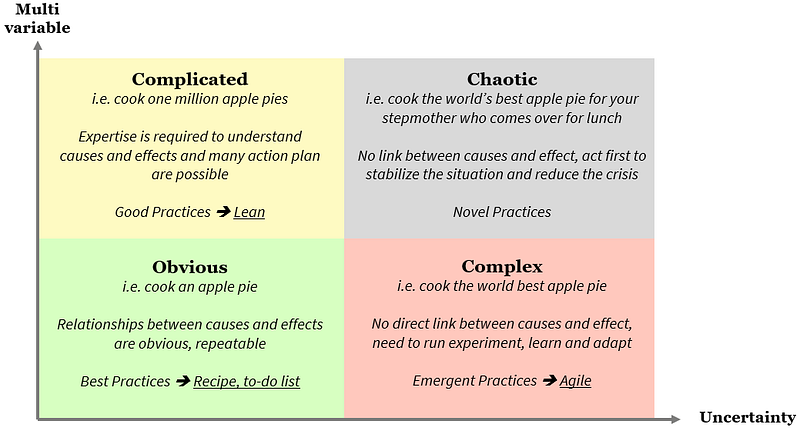
Let’s dig into it.
1. The obvious: Cook an apple pie
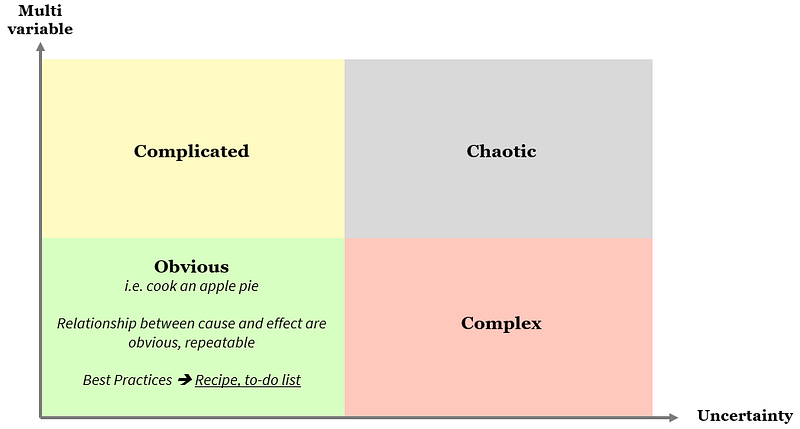
The «obvious» work has two specific attributes: the full project is easy to grasp with a single mind and there is little uncertainty. This type of work is your day to day activities. Relationships between causes and effects are obvious: you know how to operate and if it is not the case, a simple to-do-list will help you.
In this situation, the best approach is to:
- Sense what the problem you are trying to solve is
- Categorize the problem
- Act according to pre-established best practices

Agile principles make little sense here. Don’t think about an “apple-pie-MVP”, nothing good will come out of it.
2. The complicated: Cook 1 million apple pies
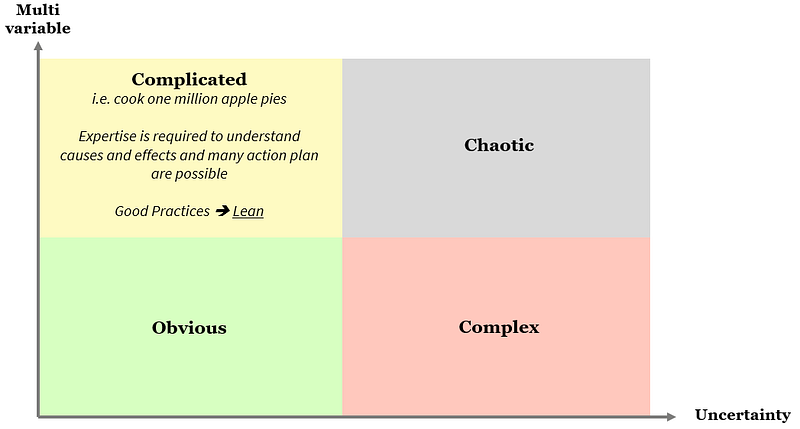
The main difference with the obvious work is the number of variables: it can be additional constraints, components, interactions…
How to cook a MILLION apple pies?

Should I hire 1 million bakers for 1 hour? Should I hire 100 000 bakers for a day? Should I peel all the apples before? How many ovens are necessary? 1000? 10 000? How long will it take?
The main challenge for complicated work is to identify which levers make sense since many optimizations are available.
The right answer is provided by lean principles and experts of “apple pie cooking”: bakers.
For this kind of problem, you will need to:
- Sense what is the problem you are trying to solve
- Analyze it
- Use good practices on some specific levers
Tools like value mapping process, constraint analysis, system thinking, stock management are necessary to limit waste and produce these one million apple pies quickly.
Agile practices are a little at odds here. It is like hitting a nail with a screwdriver. It is somewhat inefficient but in the end if you adapt the practices according to the situation, something good eventually comes out of it.
3. The complex: Cook the world best apple pie
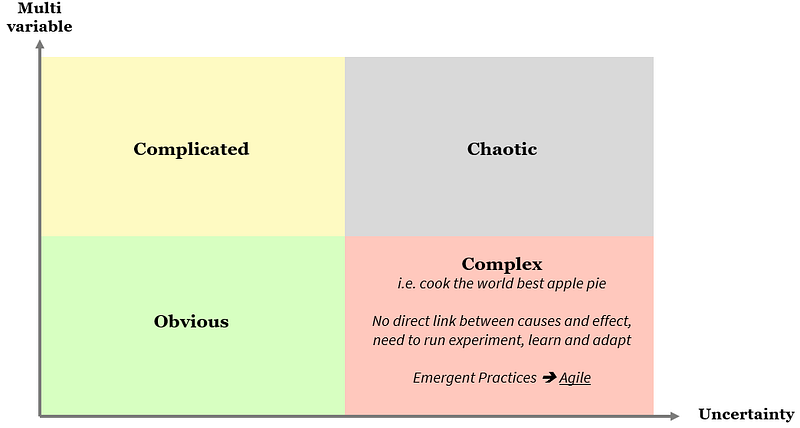
This is a completely new area. For complex problems, there isn’t a clear relationship between causes and effects: one can not be certain that a certain set of actions will produce a certain result. The objective is to discover the hidden rules that will help you produce the expected results.
What is the best quantity of flour for an apple pie? Which type of flour is the most suitable? Is there a magic ingredient to be added?
This multitude of possibilities means that you will need to run experiments, fail and repeat in order to get closer to your final result.
This is the cornerstone of agile approaches.
At first, the final result might be unclear:
Who is the final Jury? How do they prefer apple pies to be like? Who will be the competitors? What will their apple pies be like?
In this type of situation, the best approach is to:
- Test your hypothesis
- Analyse the results
- Adjust your work
Agile shines when what needs to be done and when the interactions between causes and effects cannot be predicted.
It is especially true when considering the “updated” version of the Agile Manifesto published by Disciplined Agile:
Individuals and interactionsover processes and tools Consumable solutions over comprehensive documentation Stakeholder collaboration over contract negotiation Responding to feedback over following a plan Transparency over false predictability
4. The chaotic: cook the world’s best apple pie for your stepmother who comes over for lunch
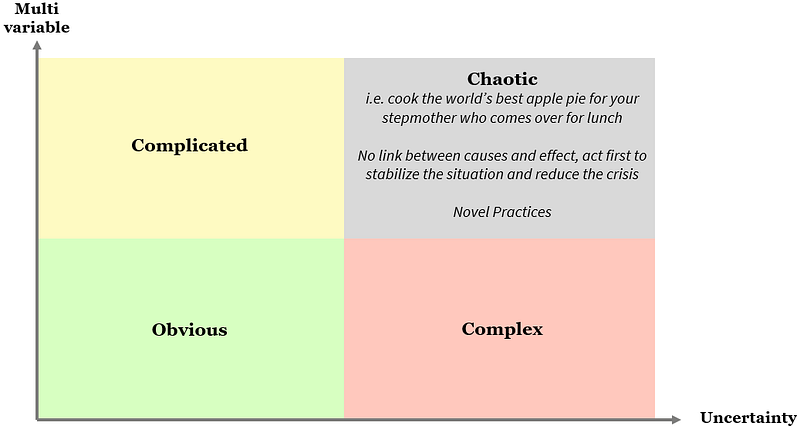
If the number of variables greatly increases (or the scope of the project, or the constraints, or the interactions), the situation becomes much more difficult to manage.
Up to a certain point, Agile scaling framework (Less Huge, SAFe, DA) can be leveraged to meet these challenges.
Unfortunately, if the size or urgency of the problem to be tackled increases, no good practice, or agile methodology can help you.
The best course of action is to:
- Act quickly
- Figure out what happened
- Adjust your work
Another option is to figure out how to slice the problem into manageable parts and come back to a complex (few variables high uncertainty) or complicated (many variables low uncertainty) situation.
As a summary
If you want to accomplish something, Agile is not always the silver bullet.
First thing first, identify the type of situation you are in.