That’s it: next year’s budget is done, the hiring plans are wrapped up and the teams have started working on the new priorities.

But this is only the beginning of the road; now you have to track budget consumption. Indeed, between the budget plan and the reality of its execution, there is often a significant gap. One project turns out to be more complex than expected. One partner decides to revisit the terms of the contract. An unexpected event forces a review of all priorities (COVID, the war in Ukraine, strikes…).
Moreover, knowing how the IT budget is consumed and being able to split it across the different business functions provides visibility into the profitability of the company’s various products.
All these processes, however, require efforts big enough to make the best CIOs and CFOs wince.
So here is a recap of good practices for tracking and allocating the costs of IT functions.
1. Start-ups and micro-businesses: One company and a single product
At first, tracking and allocating costs is relatively simple. The company has just been founded; it offers only one product, or a fairly narrow range of products.
It has an IT team with a budget and initiatives. It records costs every month, and the finance department can directly link this IT spending to the product sold. Cost allocation is therefore not an issue.
The company focuses instead on properly prioritizing and executing its initiatives.

2. Scale-ups and SMEs: Multiplying products
As the company grows, new products appear, or new product lines that require specific developments. For example, where the company used to develop a product for consumers, a new offering is launched for professionals, with different services, a different customer journey and different applications.
The IT teams will then specialize: one team will keep working on the consumer product while another moves on to the new product. In this situation, one can also imagine that part of the IT teams remains shared, for needs common to both products, or to meet internal management needs (HR, Finance…).
If the CFO wants a full cost view of the 2 products, they will have to:
- allocate the cost of the dedicated team working on each product
- split the costs of the shared team in two using allocation keys
Many options then exist for handling this shared team: an even split, a pro rata based on revenue, on the number of salespeople, of customers… The overall mechanism remains simple, but it provides a fairly detailed view of each product’s profitability and helps steer funding decisions.

3. Corporations: Multiple entities across multiple countries
Things get more complicated when new legal entities are added to the company’s operational scope. This is often the result of one of the following situations:
- acquisition of a competitor
- creation of a dedicated entity to handle a new product
- creation of a dedicated entity with its own IT in a new country
Many legal and tax constraints then come into play, and it is absolutely essential to get support from lawyers and accountants to carry out these operations.
From a cost tracking standpoint, this is when the real difficulties appear. Let’s limit ourselves to the difficulties raised by IT teams.
In such a system, you are likely to end up in a situation like this one:
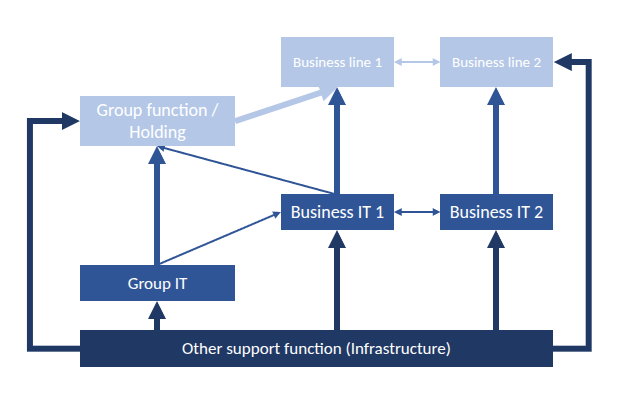
Each IT entity works mainly for its own business line, but may also serve the needs of other entities. This diagram is the “simplified” version of how every large group operates.
In a diagram like this one, an invoice from “Other support function” will potentially go through 2 or 3 players before reaching the final business line.
How, then, do you give the decision-makers of business line 1 good visibility into the IT contribution needed to run its activities? How do you reallocate the right operating costs to it accordingly?
To answer this question, let’s look at the specific case of staff costs.
4. Allocating staff costs
For the cost of people (internal or external), the simplest part concerns the projects carried out. Projects are, by design, known in advance. It is then possible to ask IT teams to declare which projects they worked on (via time tracking).
Based on this declaration of time spent, the teams’ costs are then allocated to the various business lines that requested these projects. It is therefore easy to get visibility into the staff costs allocated to projects.
For production/run activities, it is a little more complex; two options are then possible:
- Application approach: identify the applications the teams contributed to, and use allocation keys between these applications and the business envelopes
- Activity approach: break down the IT teams’ work into pre-identified activities so that these activities can be allocated to business envelopes
But another subtlety quickly appears: which costs should be allocated to the business?
The actual cost incurred? That is, for internal staff, each employee’s specific monthly salary? At the risk of making each employee’s cost transparent?
Use a standardized cost with the same daily rate for all internal staff?
Use a standardized cost that factors in the resource’s seniority to differentiate broad categories of profiles?
And then how do you account for all the costs surrounding IT resources? They do occupy buildings, use furniture, PCs, screens and other IT equipment. They also benefit from HR services, and from all the services of a large group.
All these costs would then potentially need to be added and spread on top of the direct costs of IT resources (salaries) when they are reallocated to the business.
But these HR functions themselves use PCs and IT services, which require IT staff. Which creates an infinite loop of allocation and redistribution.
We begin to understand the complexity CFOs and CIOs face in giving a clear view of how their costs are distributed.

5. How to simplify cost tracking?
Large groups quickly find themselves in a situation where the cost tracking and allocation model becomes so complex that it becomes counterproductive.
Dozens of people and hundreds of hours are needed every month to rebuild a view of costs by business line, through multiple allocation keys and cascading management rules that make any explanation of a decrease or an increase impossible.
And despite all these resources, IT and finance can no longer simply explain how the IT cost envelopes are distributed, nor offer relevant decision levers for management.
The business thus has to fund a management function that is expensive and does not answer its financial questions, even the most basic ones.
It is by reaffirming the “why” of these cost allocation models that these large corporations manage to get out of these dead ends:
Gain visibility into IT’s contribution to business activities in order to make the right investment decisions
The model’s precision therefore becomes less important than its intelligibility and its usability.
Allocation/billing flows
The first answer lies in simplifying intra-group flows. One of the big rules is to limit circular financial flows at all costs, and cross flows between entities as much as possible.
In international groups, this approach also helps limit the taxes paid by limiting flows, such as intra-group VAT.
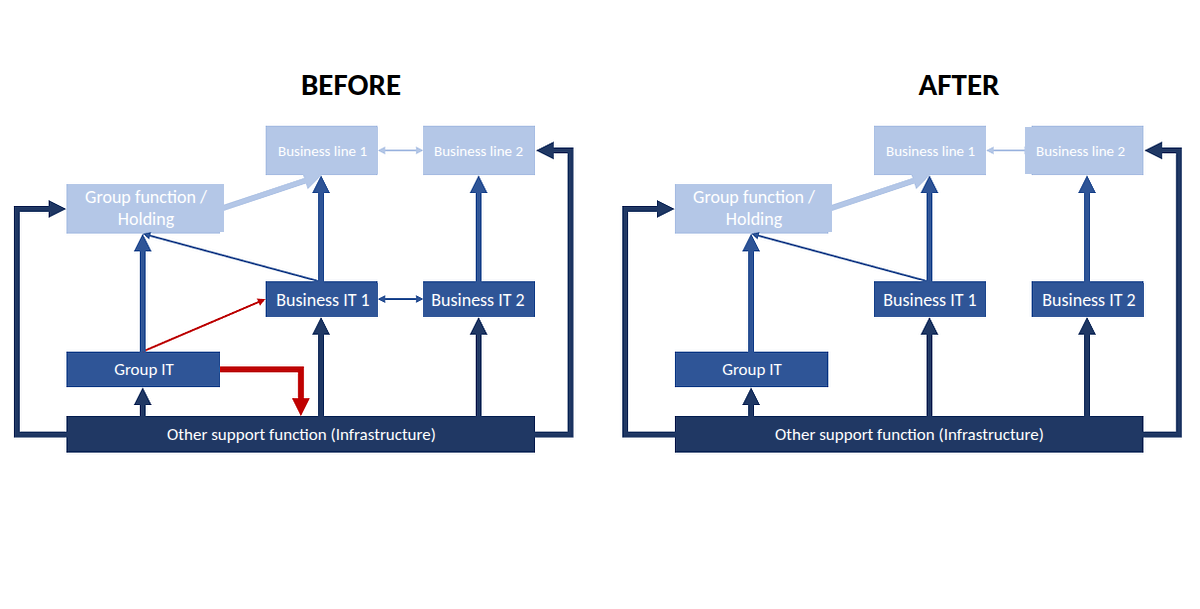
One example of this in practice is prohibiting cost allocation between IT support functions:
Or even between all support functions:
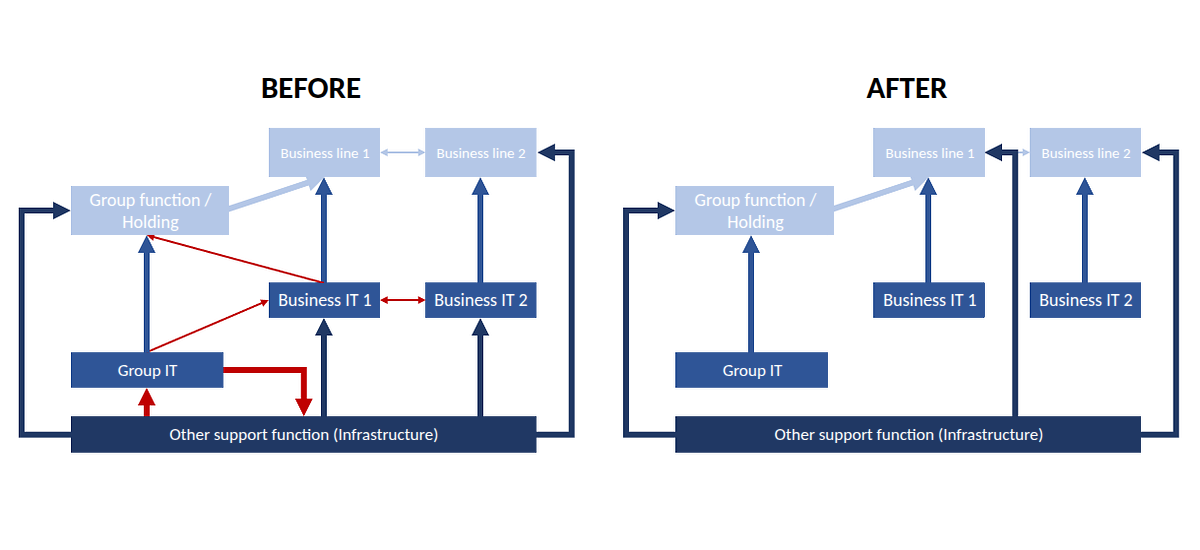
Costs are thus billed directly to the final business teams, to simplify flows between intermediate entities.
We can then move from a system where the cost of the “Other support function” team is billed directly to Business line 1 rather than going through 3 intermediaries (Group IT, Business IT, Group function) with their own allocation keys and management rules.
Implementing this is not trivial, however, because it requires each entity to have a good grasp of who the final customer of its activities is.
6. Setting up a service catalog
The second answer involves creating a service catalog.
In this approach, each support function defines a list of products/services it offers to its partner entities for the coming year.
Thanks to monitoring tools and tools that measure resource usage (data counters, activity logs, management tools…), the IT department can then identify how many resources each customer uses.
Once IT service consumption is measured, costs can be distributed according to that consumption: you take the total cost of the service, and bill internal customers pro rata to their usage. For example, if a business entity uses more storage capacity or computing power, it will be billed accordingly.
This consumption-based approach has several advantages. It allows a fairer distribution of costs, since each business entity only pays for the services it actually uses. It also encourages better management of resource consumption, since business entities are directly responsible for the costs associated with their usage.
The issues
However, this approach can also present challenges. It can be difficult to measure IT service consumption precisely, especially when resources are shared among several business entities.
Moreover, if a business line ultimately decides not to consume part of the resources that had been budgeted for it, all the other customers will, by a knock-on effect, have to make up the shortfall, and will thus see their costs go up.
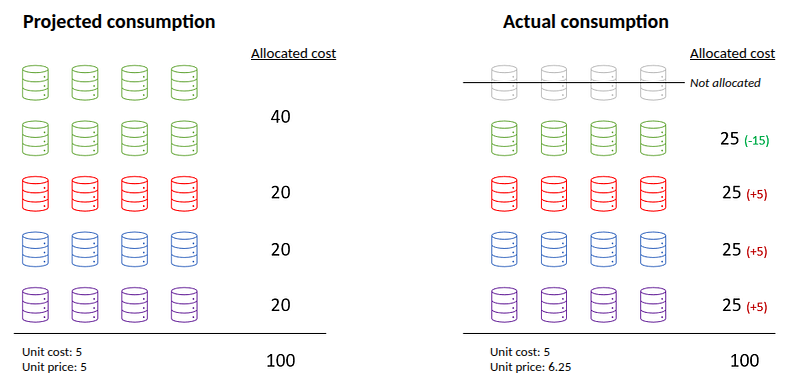
In this example, the “green” business line ended up using only half of the 8 servers allocated to it at the beginning of the year. To keep the IT department’s costs balanced, the cost of these unused resources has to be reallocated across all players. The red, blue and purple business lines therefore end up with higher server costs. The reallocated amount goes from 5 per server to 6.25, a 25% increase!
In real life, for a catalog with hundreds of services, hundreds of unit cost variations, consumption gaps, and dozens of customers, you can easily imagine the bloodbaths this can lead to.
A new simplification path: fixed prices
In the previous example, the business lines’ discontent came partly from their uncertainty about the amount that would be allocated to them: it depended heavily on the behavior of the other business lines.
To limit these side effects, a simple mechanism is to fix prices. A server will therefore cost 5 for the IT department, and will be reallocated to its business lines at a unit price of 5.
But at year end, by keeping a price of 5 for all its customers, the IT department implicitly accepts creating a deficit of 20 on these server costs. Across all its services, however, it can hope that all its variances balance out.
A dedicated article will soon be shared on all these service catalog management mechanisms and their best practices.
Conclusion
In short, allocating and tracking IT costs is a major issue for a great many IT players.
Without a structured simplification effort, financial controllers, CFOs and CIOs can very quickly find themselves in the middle of a plate of spaghetti that is very expensive to maintain and provides no visibility to decision-makers.
And the many client cases confirm it: for this topic in particular, simplicity is the key to effective cost management.