
ChatGPT needs no introduction.
- Developed by OpenAI
- 100 million users in less than 2 months
- New features and use cases every week
- Content created instantly about anything and everything
And according to the latest studies by Microsoft and Goldman Sachs, hundreds of professions and millions of jobs are at risk of being AI-placed.
With their image as “slide churners,” consultants are obviously in the crosshairs of these revolutionary tools.
But make no mistake: consultants still have a bright future ahead of them, and here’s why.
Here we will focus specifically on management consultants (see previous article), but some of the findings carry over to other types of consultants. Enjoy the read!
In the left corner, LLMs (Large Language Models)
LLMs such as ChatGPT work by analyzing huge amounts of text data in order to learn the patterns and structures of language.
They then use this knowledge to generate coherent and relevant answers to the questions they are asked. With GPT 4.0 leading the charge, LLMs far exceed the writing and summarizing abilities of almost every individual.
Along the same lines, there are also many tools capable of generating PowerPoint presentations in a few seconds to answer questions, such as SlideGPT, Tome.App…
Even if the result is not always relevant today, with new iterations of these tools and a constant improvement in the quality of prompts (user inputs), the results are very likely to become more and more impressive.
In the right corner, consultants
For our comparison with ChatGPT, let’s focus on 2 key consultant skills: problem solving and written deliverables. We therefore set aside oral presentation skills and project management, which seem more minor and, for now, outside ChatGPT’s scope.
A consultant’s mandate is to solve their client’s problem.
To do so, they are asked to analyze complex situations, identify the underlying problems, and propose solutions tailored to their client’s specific needs.
This skill requires a deep understanding of nuances, organizational dynamics, and specific contexts.
So the consultant is not there to repeat some theoretical best practice. Besides, these best practices are, most of the time, available almost for free on the internet or in specialized books.
If clients pay what are often large sums, it is so that consultants take the trouble to understand their specific problem and, based on what is at stake for them, identify possible solutions. And then, through iterative work with the client, adjust these recommendations and put them in place.

The “real” added value of the consultant
Clarifying the Chaos
Any consultant will tell you: the first and main difficulty on an engagement is often the chaos of the organization they are brought into:
- no consensus on the current situation
- diverging opinions on the target to pursue
- contradictory demands on the transformation plan
So, contrary to what one might think, the consultant’s main job is not to serve up advice on a platter about which solution to adopt. There are often already experts on site, with a very clear vision of the transformations to put in place. But amid the surrounding cacophony, these experts are not known/heard/listened to/followed.
The consultant’s main job is therefore to:
- bring out factual elements about how the organization works from its chaos, to build a common foundation for identifying areas for improvement
- collect the good ideas and make them converge toward a solution that integrates all the constraints and addresses the client’s problems
Of course, a good command of the underlying business subject, through deep expertise and similar experiences, is necessary. This knowledge will help the consultant, for example, steer the client toward a target that follows market best practices.
But in most cases, some people at the client already know the possible answers. The fog and organizational chaos “just” prevent these solutions from emerging and from becoming obvious to all the other stakeholders.
To understand this better, we can use, for example, the metaphor of the elephant:
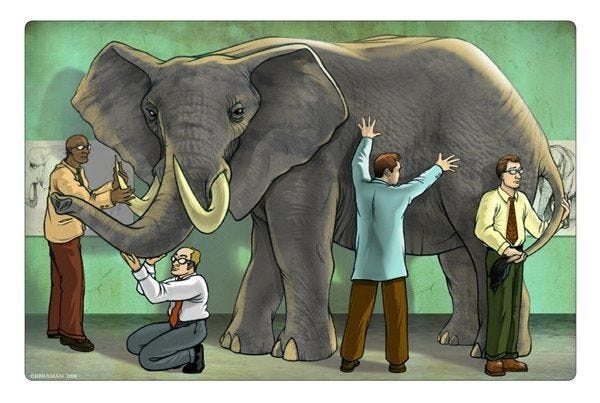
In the dark, a person touching an elephant’s leg might think it is a tree, another one at the trunk might think it is a snake, a third one at the body might think it is a wall.
They are all facing the same elephant, but with their limited perspective, they struggle to get the big picture, to step back and identify the animal.
By interviewing each person and formalizing with each of them their level of understanding of the problem, the consultant can iteratively bring out the organization’s real situation.
— — — — — — — — — — —
An aside on “limited perspectives”
In large organizations, with dozens of hierarchical levels, hundreds of managers and teams, and thousands of employees interacting every day for decades, organizational complexity very quickly becomes colossal.
It is utterly impossible for one individual to have a detailed understanding of all the mechanisms at work, and of their impacts:
- Top managers have a very broad but superficial view, often blurry and disconnected from operational reality
- Teams have a very precise but necessarily limited view of what is happening and of the organization’s broader stakes.
By talking with each hierarchical level, the external consultant can more easily form a true picture of reality.
Following the same logic, all initiatives aimed at facilitating and structuring exchanges and sharing, both horizontally (between teams) and vertically (with management, upward and downward), are essential to limit the myopia biases described in the elephant metaphor.
End of the aside
— — — — — — — — — — —
Modeling, mapping, describing
On top of the complexity inherent in the multitude of perspectives and conflicting opinions, one last point contributes to organizational chaos: the lack of reliable, up-to-date documentation on how the organization works.
So the consultant’s first task is often to:
- formalize a process and its actors
- describe a governance and the exchanges between entities
- map an organization, or roles
In my experience, documentation describing the problem the client is asking about rarely exists.
And that’s quite normal!
Indeed, as explained above, describing a problem is in itself the beginning of solving it. A client who devoted the necessary time and effort to describing their problems would solve 80% of them on their own.

And what about LLMs in all this?
Let’s get back to LLMs, and to why they will not replace consultants.
Earlier, we saw that a consultant’s first skill is:
Synthesizing the organization’s complexity into factual elements shared by all the actors
By nature, language models or generative AI are trained on very large volumes of data. But in the specific case of clients’ problems, they face a double constraint:
- the data does not exist and/or is not in a form that generative AI can easily consume
- the problem, and therefore the approach to solving it, is multi-dimensional and specific to each client, with a shallow learning depth
Every word matters in this 2nd point, so let’s take it one step at a time.
Multi-dimensional
The problem (and its solution) can involve tools, groups of people, individuals, interactions, organizational structures, information flows, operating rules, objectives, habits, cultures… or even a mix of all of these, with short-, medium-, and long-term impacts and consequences on each of them.
Modeling and juggling all these concepts, along with the associated causes and consequences, is a difficult task for a generative AI.
Specificity
On top of the difficulty for AI of integrating the client’s multi-dimensional reality, every client is different. To the point that words and concepts don’t mean the same thing from one client to the next!
A consultant needs a lot of perspective to adapt their approach and minimize their effort (and their knack for disrupting people!) with the various client contacts. No standardization is possible, each engagement is a new discovery, with its share of surprises and adjustments.

Shallow learning depth
One might then think that it would be enough to train an AI on a great many client cases so that, with its billions of parameters, it could find hidden synergies. And it could thus adopt a specific approach for each client.
But in reality, it would take considerable effort to build this training data, and it would cover at most a few dozen companies with similar problems. Not to mention that modeling a company’s training data for an AI (on top of being very time-consuming) would almost amount to solving the problem itself.
And client problems evolve!
By definition, once a problem is solved, the client moves on to the next one. The market thus naturally drifts toward new problems, which forces consultants to keep learning in order to stay relevant.
For LLMs, this continuous training on scarce, specific, multi-conceptual, and partial data seems beyond the reach of current technologies.
What’s next?
So replacing consultants with ChatGPTs is not happening anytime soon.
YES, AIs will be able to create presentations faster and more efficiently than consultants.
YES, AIs will be able to provide answers 24/7 on elements of theoretical models, and maybe on market best practices.
NO, AIs such as ChatGPT will not be able to understand a client’s specific problem and propose tailored recommendations.
YES, the consulting profession will change dramatically in the years to come.
We can then imagine that consultants will use bots to automate the interview, data collection, synthesis, and presentation phases.
We would then have “augmented consultants,” piloting an army of specialized generative AIs and steering them toward the right topics thanks to their expertise.
Of course, the cards will be reshuffled the day artificial general intelligence is developed.
And by definition, it will be able to replace consultants.
But it will also be able to replace all non-manual activities.
And that’s another story.