Story in Frenchhere.
I’m hearing more and more about Objectives and Key Results (OKR) but I can’t quite figure out what’s behind it. Could you help me?
Good topic proposal, there are indeed lots of myths around OKR. I suggest we start with some background.
OKRs are not a new concept at all: Andy Grove developed this approach at Intel in the 1970s. As Intel’s CEO, Andy used OKRs to drive his company, turning a small tech company into a mastodon in the late 1990s. The OKRs are also largely inspired by the concept of Management by Objectives introduced by Peter Drucker a few years earlier.
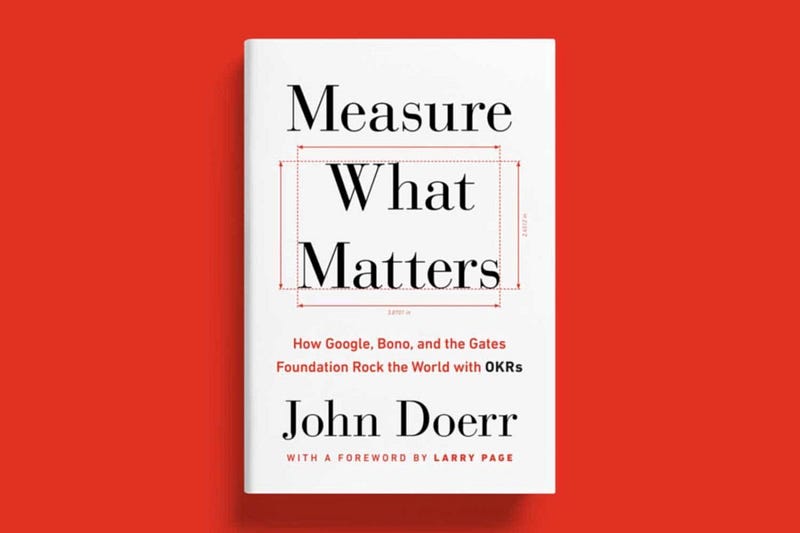
But the real tipping point for OKRs comes from Google. In 1999, when the company only had about ten employees, John Doerr, who worked with Andy Grove at Intel, managed to convince Google’s management team to use OKRs to manage itself. And you know the story, Google (and now Alphabet) is now one of the most influential companies in the world and Larry Page says it’s largely thanks to the use of OKR.
Okay I see… but why is everyone talking about it now when OKRs have been around for at least 30 or 40 years?
I would say that first there is the book that John Doerr published in 2017 which has been a huge success in management circles. His TED conference in 2018 also went viral. Then there are the many testimonials from start-ups and unicorns (LinkedIn, Twitter, Uber…) who attribute part of their success to the systematic use of OKRs. And perhaps the last element is the craze for agile practices within more traditional companies. The notions of iterative cycles and prioritization fit well with the principle of OKR.
And now, if we go into detail, what are OKRs, concretely?
Before answering you on what they are, I propose to explain to which difficulties the OKRs respond.
This is your interview!
It all starts with a few observations that you can experience for yourself. Walk through the corridors of any company and ask the following questions to an employee:
- What is the priority of your team?
- What are the main goals of your company?
- How do your team’s priorities fit with your company’s goals?
- Do you know the priorities of the team next door? The department next door?
- And in relation to all these objectives, how can you tell if you are moving in the right direction?
I don’t understand… you’re telling me that most of the employees can’t answer these questions?
Unfortunately, this is often the case. Or you risk having as many different answers as employees. So, if I summarize:
Unexplained and/or contradictory priorities between the different teams/departments
Prioritized activities without a real overview: “the one who shouts the loudest”
Low visibility on the real impact of the activities carried out
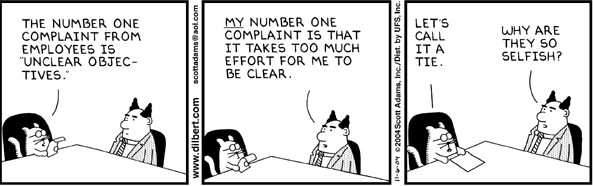
I can see the magnitude of the problem… so if I go back to ourprevious discussion, these companies are a bit like elderly people who can no longer move around as they wish. The different parts of their bodies no longer respond to the brain, or act in a somewhat disordered manner.
That’s it, but this pathology affects many companies with varying degrees of intensity. The more a company grows, the more its complexity increases, as well as the communication networks to control it. It then risk more and more develop this pathology. Without a consistent and structured effort at each level of the company to counter these problems, we get an ankylosed company.
Spiral Project Management Methodology in Healthcare | Data Driven Investor
What is this magic recipe for OKR?
The great strength of OKRs is their simplicity:
- Define between 3 and 5 inspiring objectives that give the direction in which you want to go
- For each of these objectives, identify 3 or 4 key results that will allow us to say whether you have achieved this objective.
And that’s basically it.
Wait, you’re explaining to me that by defining OKRs and thus roughly 15 sentences, any company becomes the next Google?
You’re right, there are a few more rules.
First, OKRs are defined at each level of the organization. The company manager has his OKRs, department managers have their OKRs, team managers have their OKRs and so on.
Secondly, the OKRs shall be open and accessible, i.e. everyone shall be able to see the OKRs of their managers or the teams next door. The idea is to trust collective intelligence so that everyone can adjust their OKRs to those of other teams. In this way, the system naturally aligns itself with shared priorities, the priorities chosen by the manager.
Thirdly, the OKRs shall be reviewed regularly, for example every 3 months. This means that every 3 months, each level of the organization shall ask itself whether its activities have enabled it to achieve the key results to which it is committed. Depending on the answer to this question, and the priorities of the entity that may have evolved, it readjusts its objectives for the coming quarter. It then readjusts the key results that will allow it to know whether it has achieved them and its activities in the field.
It’s a little bit like hiking, you stop every half hour, you look up to make sure you’re going in the right direction, and you adjust your route if necessary, depending on your position, the time of day, your fatigue, the sun… there are other details to understand, but I will put them here and here, you can have a look at them from time to time.

But companies are already setting goals, aren’t they? How is that revolutionary?
You’re putting your finger on an extremely important point, which explains why traditional companies are often quite dubious about OKRs. They already define objectives, as well as priorities, and they follow progress metrics. But operationally, this doesn’t work well because employees are lost between their multiple individual, team, and project objectives, the day-to-day priorities given by their boss, and the company’s overall communication about its objectives. This leads back to all the problems outlined above: too many priorities kill priorities.
So, if I summarize, OKRs are mainly about simplicity, transparency, alignment with a pinch of rigor?
A little more than a pinch… as you will have understood, defining OKRs is not very complicated, in a few hours of reflection at each level of the organization, you can get there. But the benefits are only visible in the long term when each team gets into the habit of questioning itself to make sure that its activities and priorities are in line with the objectives of the hierarchical level above, for example.

Earlier you were talking about individual goals, do these OKRs also work for individuals or is it only at the team level?
Every company is free to implement these OKRs as it wishes, you now realize that beyond a few basic principles, it is quite flexible. At Google, for example, the objectives are at an individual level. In the companies I’ve worked with, it’s more at the level of a team or a department.
By the way, I also decided a while ago to test the OKRs on myself.
You never stop… but do they cover all aspects of your life or is it just your professional life?
Ahahaha, I can tell you for example that there is an objective to develop my expertise, with 2 key results:
-
reading 6 “non-fiction book” over the quarter
-
publish 10 articles such as this one
And you’re getting there?
Answer in 3 months! and I also invite you to write your OKRs, it will help you a lot to focus your energy on the projects that make you move forward.