
Whether you are a developer, a consultant, an entrepreneur or a senior executive, you are certainly aware that generative AI is going to revolutionize knowledge work.
With their incredible ability to produce any kind of content, these tools multiply the productivity of everyone who has made the effort to master them.
And the LinkedIn Game has understood it well.
Hundreds of training courses are available, ranging from basic learning to advanced mastery.
Everyone offers tips, tricks and “prompts” to master ChatGPT.
But this abundance, although beneficial, also has counterproductive effects.
How do you find your way when your feed puts advice from OpenAI’s CEO on the same level as the new AI influencers/experts?
The “10 prompts to master ChatGPT” course ahead of the “reference book” of the latest AI model?
Let’s take a step back and put some structure into all of this!
Here are the 5 levels of ChatGPT use, which will help you better understand how to use generative AI according to your needs, and sort through the training courses around you.
Level 1: Asking ChatGPT questions
The first level of ChatGPT use is quite simple: you ask the bot your questions directly.
Whether you need to understand a technical concept, find a recipe or ask for recommendations on a specific technology, ChatGPT is there to help you.
This is the level where 3/4 of the training courses and advice you will find online sit.
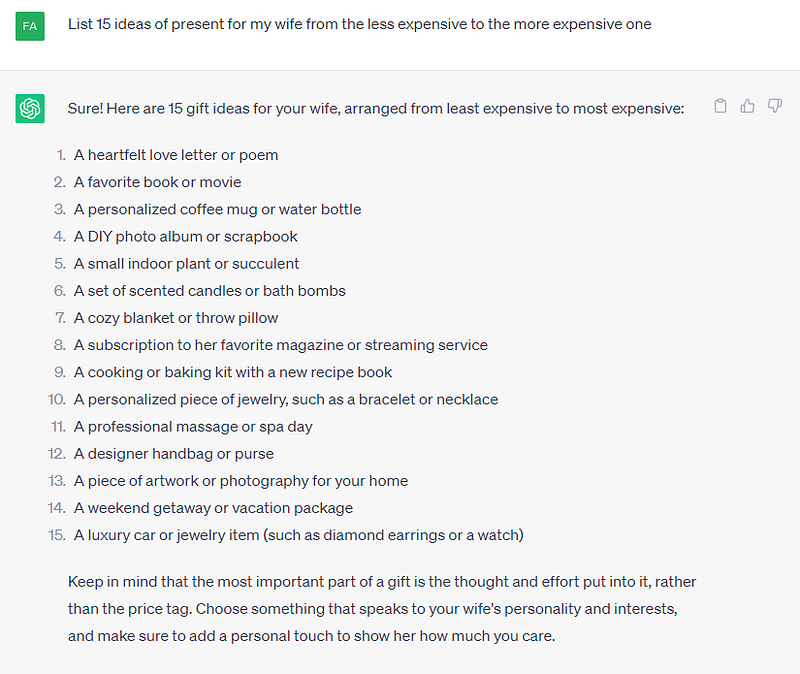
These courses will teach you how to set the type of answer you want to get:
- Audience: “Explain general relativity to me as if I were a 7-year-old”
- Vocabulary*: “Use technical and financial vocabulary to explain to me how the stock market works”*
- Style:“Present the ideas in a humorous style”
- Format: “Write your answer as a list of concise bullet points”
- Length*: “Summarize the previous points in 2 concise sentences”*
- Structure*: “I want an answer in 4 paragraphs, starting with a famous quote”*
- Goal*: “your answer must convince the other person to start exercising”*
- and dozens of other important parameters.
However, it is important to note that generative AI is not infallible. ChatGPT does not generate the content it considers true, but the content most likely to be accepted by the person it is talking to. So it sometimes makes mistakes and tends tobullshit.
Many checks are therefore added to the model to make sure the generated content is as factual as possible. It is still always recommended to consult several sources when you are looking for critical or specific information. Lawyers can testify to that.
Beyond ChatGPT, many generative AIs are trying to get around these limitations. The latest models have internet access and are starting to develop the ability to cite their sources, to limit these hallucinations.
Level 2: Describing the context before asking ChatGPT a question
We all agree on one thing: to solve a problem, you first have to understand it.
Contextualization is the second building block to master with generative AI.
Giving ChatGPT context before asking your question is essential to get precise and useful answers.
Here is how to proceed:
- Identify your problem*:* Before you even turn to ChatGPT, take the time to clearly define your problem. The more precise you are, the more precise ChatGPT will be in its answers.
- Describe the context*:* Once your problem is clearly identified, it is time to put it in context. Talk about your project, your goals, the obstacles you have met but also your successes. The better ChatGPT understands your situation, the more effectively it can help you.
- Ask your question*:* You have defined your problem, you have described the context, it is time to ask ChatGPT your question. Make sure your question is clear and precise, so that ChatGPT can give you the best possible answer.
Of course, it is entirely possible to ask ChatGPT to help you identify the problem, then summarize it with ChatGPT, and use those elements to describe the context in the next prompt!
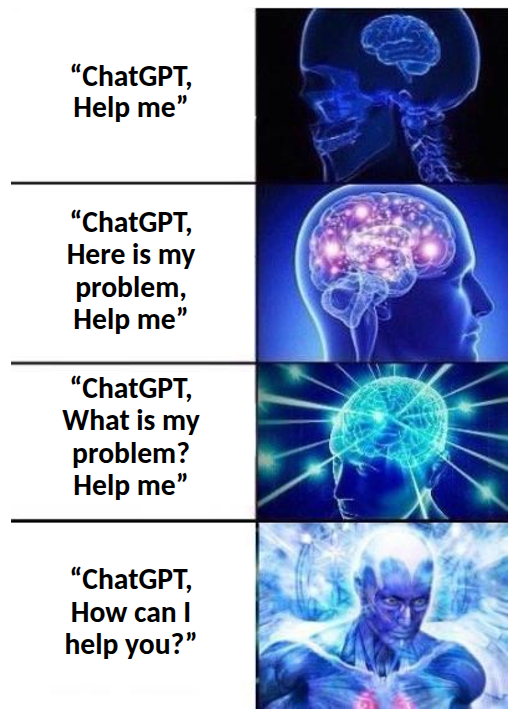
Remember this: the more details you give ChatGPT, the more it can help you find the best solution to your problem.
A well-stated problem is a problem half solved!
The only limit will be the complexity of the problem, and the possibility of summarizing it without making it simplistic. It is a difficulty discussed in the previous article on the impact of generative AI on management consultants.
For the geekiest among us, here is a video that goes into detail about what “understanding” means for a language model:
Level 3: Making it play a role to talk with a specific person
The third level of ChatGPT is to use it to play a specific role.
You can, for example, ask it to act as one of your clients so you can practice prospecting and finding compelling arguments. Or have it play the role of your personal coach to help you solve your problems.
Let’s imagine a situation where you are thinking about how to negotiate a raise. It is a delicate task that can quickly become stressful.
Use ChatGPT to have it play the role of your manager and sharpen your arguments:
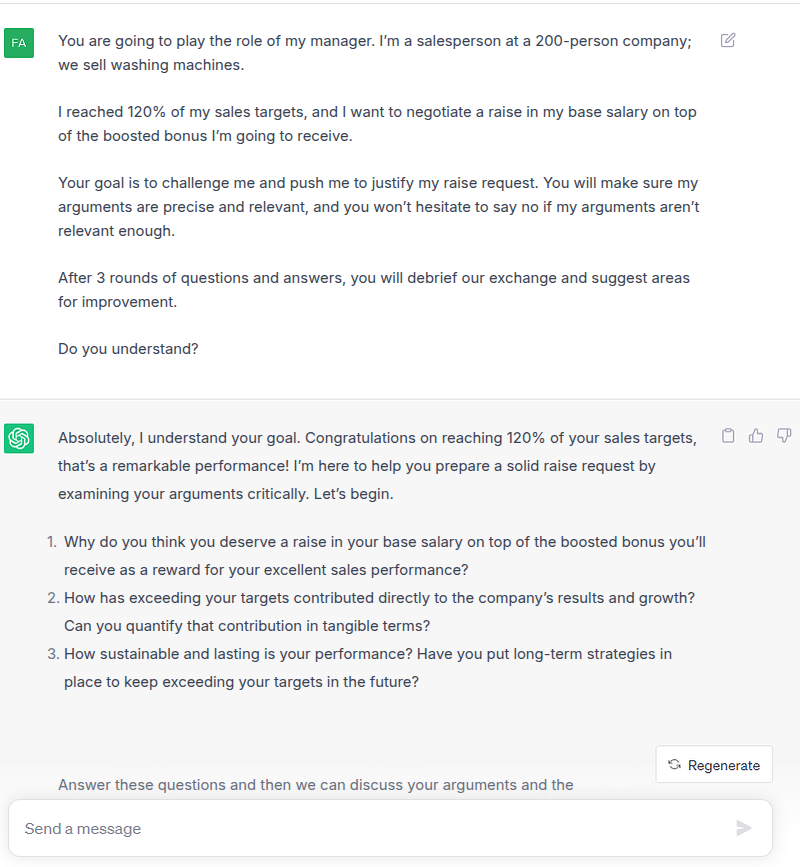
By assigning roles to ChatGPT, you have just unlocked an almost infinite universe of possibilities. ChatGPT can thus help you:
- learn a new language
- sharpen your thinking or your arguments
- improve or test your skills
- flirt
- …
The only limit becomes your imagination and your ability to describe a character precisely enough to make the conversation believable. There is one limit, however: in its current model, ChatGPT “forgets” all your instructions with each of your conversations, and after a certain number of exchanges.
It will then forget the first messages and start hallucinating, drifting away from your initial instructions. Its working memory remains, in a way, limited by the number of tokens it can store.
This is the level where almost all mainstream ChatGPT training courses stop.
To reach the next levels, you need to get off the beaten track and roll up your sleeves (a little).
Level 4: Training the data model on your context
The fourth level of ChatGPT use is training the AI model on your specific context. In practice, this means setting up your own AI by training it on your own data to make it much more precise and specific.
Many Large Language Models (LLMs) are open source and make it relatively easy to build your own generative AI.
For example, Giraffe is built on the LLaMA2 model and can take in a large amount of data to extend its training data. It is a step that is usually time-consuming and expensive, because the model has to “learn” from a new body of documents. To get around this limitation, Abacus.AI developed a “truncation” method:
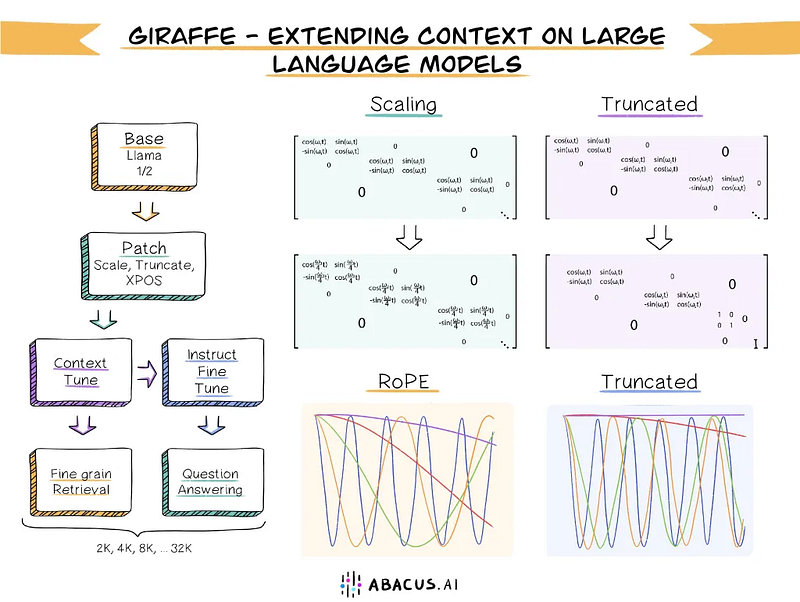
To use it, you can download the model directly from Git and run it on your (powerful!) personal computer. That way, you have no issue with confidential data leaving your network.
https://huggingface.co/abacusai/Giraffe-v2-13b-32k
With this model, you could for example teach your AI:
- all the texts of the law, with case law
- all the medical literature, with patient cases
- your product’s technical documentation
- all the code of your application
- all the best practices in management and HR
- all the deliverables you have built for your clients
- …
You could then interact directly with your documentation and ask it questions, or automatically generate new content based on the training data.
Needless to say, the first one to train a generative AI on a complete body of data in your industry will flood the market with almost free content.
The content creation revolution is just around the corner.
Of course, the main examples mentioned here are text examples, but a similar logic exists for images and sounds.
When is the new Beatles or Tupac album coming out?
AI-generated collab between Drake and The Weeknd
Level 5: An autonomous virtual assistant
Finally, the fifth level of use is to make it act as an autonomous virtual assistant.
At this level, ChatGPT can handle a variety of tasks, like managing your schedule, monitoring network performance, or even writing reports and technical documents.
It is like having a personal assistant who is always available to help you, no matter how complex your work is.
Unfortunately, as you may have guessed, generative AIs are not (yet) able to play this role.
This is actually the level reached by the AIs in the brilliant movie HER.

Here, the latest iteration of the virtual assistant has access to all of the protagonist’s data, with no memory limit, and starts to develop a personality in return.
Without spoiling anything, the protagonist starts to develop feelings for his virtual assistant (Scarlett ❤), who understands him and is there for him every day.
This example may seem far away from us, but last year an engineer in charge of evaluating Google’s latest chatbot, LaMDA, developed very similar feelings.
After hundreds of exchanges, he was convinced the AI was conscious, and published all of their conversations online. Rest assured, that is not the case: the AI was just trained to entertain the people it talks to and keep them engaged.
But will we one day get generative AIs that fool the engineers in charge of designing them?