
- two thought experiments to better understand our relationship with work
- the Tom Sawyer effect, or how to turn work into play
- the two sources of motivation according to Dan Pink
- the difference between heuristic and algorithmic approaches
- the importance of focusing on the goal, or “purpose”
Two thought experiments
1. A universe of possibilities
With a big EuroMillions jackpot on the line, you decide to try your luck. A few days later, you find yourself sitting on a small fortune. If you want, with this money you can quit your job, live comfortably for the rest of your days, and leave a solid inheritance to your children and grandchildren. As far as your professional life goes, how do you react?
- A/ You quickly quit your job for other activities
- B/ You stay in the same company, but change positions and/or activities
- C/ You carry on with exactly the same activities
2. Deep boredom
Your company’s human resources department informs you that if you don’t take your vacation days right now, you will lose them. You barely have time to hand off the urgent matters to your colleagues, and there you are, “forced” to put your professional activities on hold for a whole month. In the middle of a health crisis, you have to stay at home and start going around in circles alone in your apartment. If you had the option, knowing that “this overtime” would not be paid, what share of your professional activities would you take back up?
- A/ none
- B/ some, just the most interesting activities
- C/ all of them
These two thought experiments let you test your relationship with your current job:
How would my work be affected if it became completely disconnected from my pay?
Would I keep deliberately investing time and effort in my work, without any financial gain?
Unlike the professional world, many fields manage to mobilize our energy without promising the slightest financial reward: amateur sports, games, volunteering…
Just sit for a few minutes in a park and watch the effort invested by joggers, children, parents… running, jumping, playing. We can mobilize our attention, our effort, our thinking freely, for a long time, without needing the slightest financial incentive. And paradoxically, this sometimes intense effort is even a source of joy and satisfaction.
How could we unlock this same energy in our everyday work, so that it becomes a source of joy and satisfaction, regardless of any financial gain?
And is it even possible to unlock this source of inner energy in our colleagues?

The goal here is not to create an army of servile, underpaid employees, at our beck and call day and night because “they love their job”. It is to find keys to make their professional activities as attractive as possible, so that they can fully invest themselves in them AND draw deep satisfaction from them.
The Tom Sawyer effect
To better understand the distinction between play and work, let’s look at the adventures of Tom Sawyer, told by Mark Twain.
After playing hooky, getting into a fight, tearing his clothes and lying shamelessly to his aunt, Tom is punished by her for the whole of the following Saturday morning. He has to whitewash the fence around the house instead of going swimming with his playmates. Stung, Tom has a stroke of genius when his friend Ben comes by to taunt him in the middle of his chore.
“Tom wheeled suddenly and said: “Why, it’s you, Ben!
- Say — I’m going in a-swimming, I am. Don’t you wish you could? But of course you’d druther work — wouldn’t you? Course you would!
- What do you call work?
- Why, ain’t that work?
- Tom resumed his whitewashing, and answered carelessly: Well, maybe it is, and maybe it ain’t. All I know, is, it suits Tom Sawyer.
- Oh come, now, you don’t mean to let on that you like it?
- Like it? Well, I don’t see why I oughtn’t to like it. Does a boy get a chance to whitewash a fence every day?”
That put the thing in a new light. Ben stopped nibbling his apple. Tom swept his brush daintily back and forth — stepped back to note the effect — added a touch here and there — criticised the effect again — Ben watching every move and getting more and more interested, more and more absorbed.
“Say, Tom, let me whitewash a little.” Tom considered, was about to consent; but he altered his mind: “No — no — I reckon it wouldn’t hardly do, Ben. You see, Aunt Polly’s awful particular about this fence — right here on the street, you know — but if it was the back fence I wouldn’t mind and she wouldn’t. Yes, she’s awful particular about this fence; it’s got to be done very careful; I reckon there ain’t one boy in a thousand, maybe two thousand, that can do it the way it’s got to be done.
- No — is that so? Oh come, now — lemme just try. Only just a little — I’d let you, if you was me, Tom.
- Ben, I’d like to, honest injun; but Aunt Polly — well, Jim wanted to do it, but she wouldn’t let him; Sid wanted to do it, and she wouldn’t let Sid. Now don’t you see how I’m fixed? If you was to tackle this fence and anything was to happen to it —
- Oh, shucks, I’ll be just as careful. Now lemme try. Say — I’ll give you the core of my apple.
- Well, here — No, Ben, now don’t. I’m afeard —
- I’ll give you all of it!” Tom gave up the brush with reluctance in his face, but alacrity in his heart.
And while the late steamer Big Missouri worked and sweated in the sun, the retired artist sat on a barrel in the shade close by, dangled his legs, munched his apple, and planned the slaughter of more innocents. There was no lack of material; boys happened along every little while; they came to jeer, but remained to whitewash. By the time Ben was fagged out, Tom had traded the next chance to Billy Fisher for a kite, in good repair. ”

What can we conclude from this excerpt?
- work is an activity imposed on us against our will. As the Latin origin of the French word travail suggested: tripalium — to torment, to torture
- play is a voluntary, free, unconstrained activity
- the very same activity can therefore be seen by two different people as imposed work or as deliberate play
- the deciding factor is our perception of that activity, and how it is presented to us
So we see that, to some extent, a constrained activity (work) can turn into a deliberate activity (play) simply by changing how we perceive it.
Tom’s friends worked for pleasure, regardless of any reward. And if Tom Sawyer were our manager, he would surely manage to convince us to cheerfully carry out even our most tedious tasks.
Motivation, at the heart of taking action
When we have to accomplish a task, we instinctively and effortlessly compare the energy it requires with its purpose.
In practice, we all know what to answer if our neighbor asks us to block off our Saturday afternoon to assemble his IKEA wardrobe. And that answer is entirely personal: it depends on our values, our preferences, our skills…
This comparison is not the result of a scientific calculation, just a comparison between the “pros” and the “cons”.
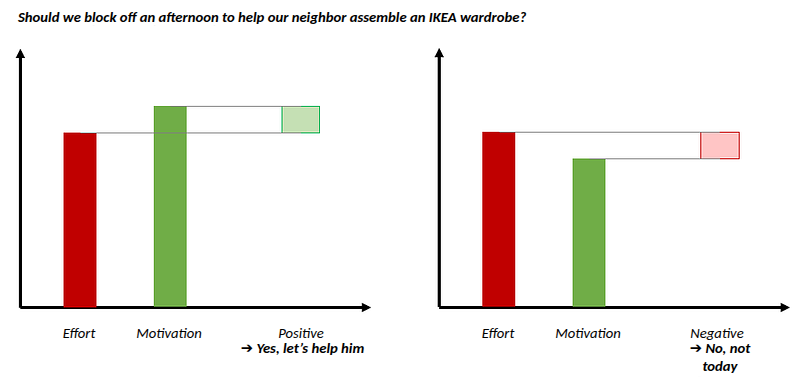
So a team leader has two levers at their disposal to get their teams moving: reduce the effort needed to accomplish the action, or increase their motivation.
Reducing the effort needed comes through better tools, more training, and many other solutions we won’t cover here. Let’s focus on the levers of motivation.
The two sources of motivation
In his book “Drive: The Surprising Truth About What Motivates Us”, Dan Pink explains that there are two main sources of motivation that push a person to act: extrinsic motivation and intrinsic motivation.
He speaks of extrinsic motivation when something external pushes us to act. For fear of losing his phone, a teenager may decide to study his history lesson and get a good grade on his next test. Without the external pressure from his parents, he certainly won’t study the lesson on his own. Extrinsic motivation can also rest on something positive: with the promise of a new computer if he graduates high school with honors, the same student may redouble his efforts during the school year.
Extrinsic motivation is the “carrot and stick” system that we see at work around us every day: fines, penalties, yellow cards, but also bonuses, incentives, promotions…
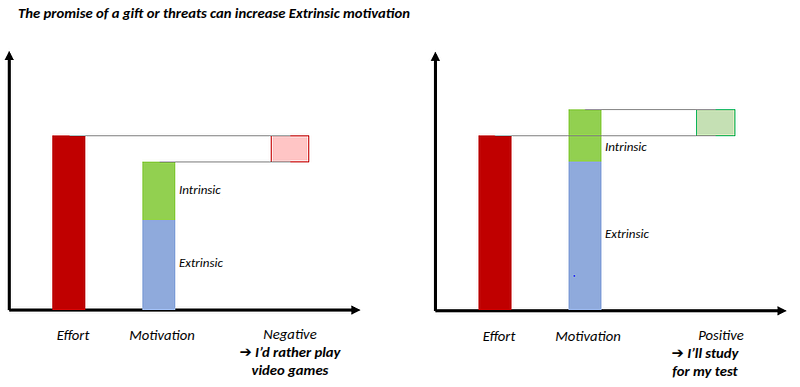
Intrinsic motivation, on the contrary, comes from each of us. We carry out a task because we like it, because we find it worthwhile for its own sake, beyond any positive or negative consequence.
That is the technique Tom Sawyer used. By faking excessive motivation, he clearly shows his friends that the effort needed to paint the fence is smaller than the benefits he gets from it. And his friends fall for it: they increase their own intrinsic motivation, to the point of wanting to paint in his place.
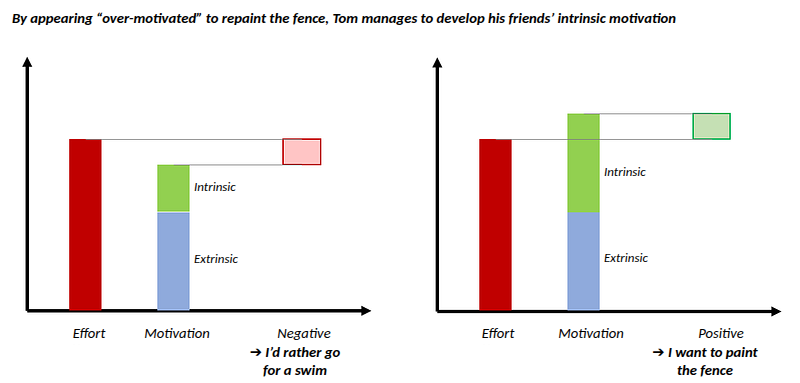
The manager’s role would then be simple: increase both sources of motivation of the members of their team, until they far exceed the effort the task requires.
However, in practice the “carrot and stick” system runs into many limitations:
- Little room for maneuver — Many tools protect employees in a system governed by extrinsic motivation: employment contracts, unions, labor laws… Forced labor is now abolished in France, and managers don’t have unlimited budgets to hand out bonuses and motivate their teams that way
- Incentives that don’t last — The teenager who started studying in the hope of getting a computer will not keep up the effort once his diploma is in hand. His parents will have to find another carrot or another stick to push him to succeed in college
- A habituation effect — On top of depending on external incentives, the teenager risks getting used to them, and asking for more to succeed in his studies. From a computer, his threshold for taking action may rise to a driver’s license, a scooter, even a car…
So there is a threshold effect for external incentives: beyond a certain level of bonus or threat, motivation no longer increases or no longer lasts over time.
A manager can therefore only truly rely on the intrinsic motivation of the members of their team to spur them to action.
Heuristic versus algorithmic approaches
According to Dan Pink, 3 conditions are needed to develop intrinsic motivation: autonomy, mastery, and purpose.
Employees are more motivated when they have some latitude over their activities. The goal and the expected results are known, but the means to get there are left up to them.
A software developer, for example, has some freedom in how to build the feature their client asked for. And all of their expertise comes from their ability to build that feature using the simplest, best structured or least costly approach.
All these activities where the path and/or the destination are not predefined call for heuristic approaches. For this type of task, it is relatively easy for employees to develop their intrinsic motivation.
Dan Pink on the surprising science of motivation
However, it is naive to believe that every activity offers the chance to develop mastery with full autonomy. Filling out a form, assessing a level of risk, checking a transaction are predefined, standardized and often repetitive actions.
These activities are characterized by an algorithmic approach: there is only one way to proceed, known in advance, to reach the desired goal.
For these activities it is very hard to give teams latitude over how to accomplish them (autonomy), and to help them develop their expertise to get there (mastery).
How do we get out of this dead end and maximize employee motivation, even for repetitive and tedious activities?
“Find the higher purpose”
The only lever the manager can really use is the goal, the “purpose” of the activity. Every action in a company normally contributes to a larger whole: identifying that link and making it explicit gives more meaning, even to repetitive tasks. If that is not the case, the activity can (and must) be eliminated, because it brings nothing to the company.
One of the manager’s missions is thus to present the activity from the angle that best matches the values and deep aspirations of the members of their team.
And the potential of intrinsic motivation is almost infinite. Charismatic managers, gurus, visionaries, Tom Sawyers and narcissistic perverts can all attest to it, for better and for worse. They are masters at influencing our perceptions, our values, and pushing us to action.
Many employees complain that they can’t find meaning in their work, and bullshit jobs are still very much with us. In reality, not all of us are lucky enough to have an inspiring manager who manages to explain to us why what we do matters.

On the other hand, I remain convinced that we can influence our own motivation to a large extent by making the effort to find the broader meaning of our actions. This conviction is illustrated by the parable of the 3 stonecutters.
When a traveler asks them what they are doing, the first one answers bitterly: “I’m breaking stones. My back hurts, I’m thirsty, I’m hungry. But this painful, stupid job is all I could find”.
The second one explains: “I’m a stonecutter. It’s hard work, you know, but it lets me feed my wife and my children. And after all, I’m out in the fresh air, there are surely worse situations than mine “
The third, a little further on, wears a broad smile and brings his sledgehammer down with enthusiasm on the pile of stones. “What are you doing?” asks the traveler.
“Me, the man replies, I’m building a cathedral!”
Conclusion
The relationship between work and pleasure is much more complex than it seems. To a large extent, our motivation can be influenced by our manager. By connecting the activity to a greater purpose that answers our aspirations, they can unlock almost unlimited resources in us. And to some extent, we can increase our own intrinsic motivation ourselves and turn our work into pleasure.
One may wonder whether, when human work answers desire, that is, the existential question, by bringing the imagination into play, it can still keep its name? Henri Laborit
The two thought experiments in the introduction thus let you measure the balance between your two sources of motivation:
- if you answered “A”, you are mainly motivated by external incentives in your work. Have you taken a step back to look at what your work contributes? Are you sure about your career path?
- if you answered “B”, you have found a balance between external incentives and your deep aspirations, well done!
- if you answered “C”, your work is a source of deep satisfaction and fulfillment. Congratulations, but watch out for burnout…