Since 2020, the same chart keeps going up. Every year a new barometer, a new record, a new right-to-disconnect charter. The problem is not that we measure badly. It is that we intervene where it changes nothing.
Over the past two years, I have seen several people around me collapse. Not fragile people. Some of the most committed professionals I know: the ones who get handed the complex cases, the ones who answer emails at 11 p.m. without anyone asking them to, the ones everyone says carry the team.
In the weeks before, the signals were easy to read. For everyone. Colleagues saw them. Managers too. Sometimes HR.
Nobody did anything useful.
And every time, the same question: did anyone really want it to change?
What I observe on the scale of a few people, the 16th Empreinte Humaine barometer confirms on a national scale. In June 2026, 50% of French employees are in a state of psychological distress, a record level since the barometer was created in March 2020. Severe burnout has doubled since Covid. It now affects 11% of employees, compared with about 5.5% before 2020.
It is not a question of measurement. What I want to understand is why the numbers don’t change practices.
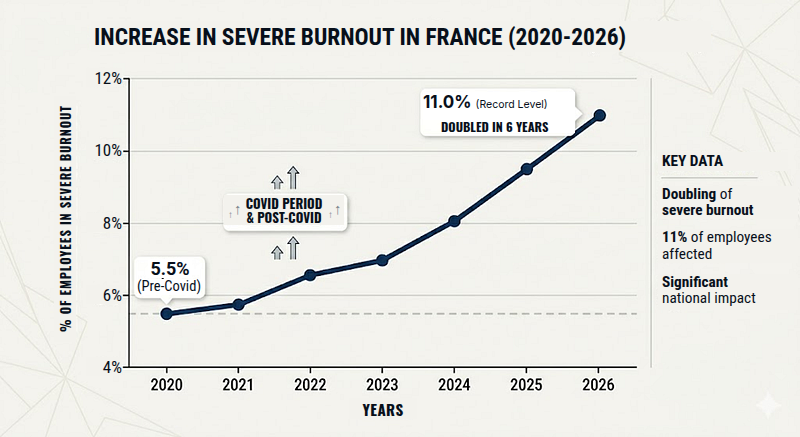
Six years of records
Christina Maslach and Susan E. Jackson formalized the Burnout Inventory in 1981 at Berkeley. Forty-five years of standardized measurement. On May 28, 2019, the WHO included burnout in its International Classification of Diseases (code QD85), not as a disease, but as an “occupational phenomenon,” resulting from “chronic workplace stress that has not been successfully managed.”
This detail is not trivial. The WHO explicitly says that burnout is an organizational phenomenon, not an individual one.
Organizations, for their part, often keep treating it as an individual problem.
28% of employees believe their leadership is pursuing a real prevention strategy. Empreinte Humaine has been documenting it since 2025.
72% think the opposite.
The wrong level
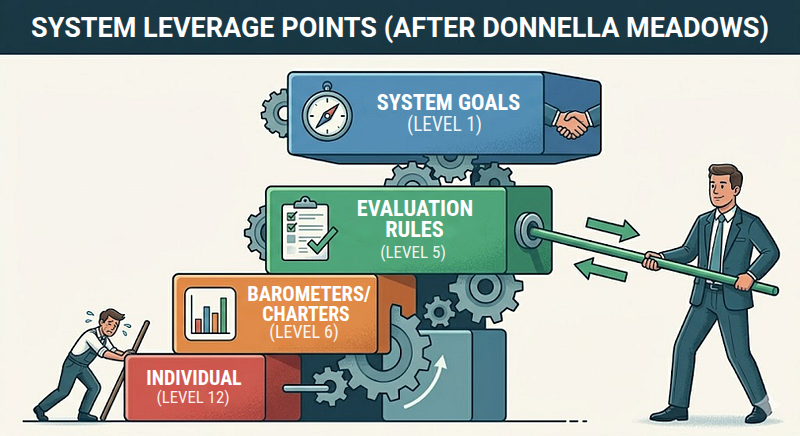
Donella Meadows was a systems dynamics researcher. In her posthumous book Thinking in Systems (Chelsea Green, 2008), she mapped the leverage points of a complex system in increasing order of effectiveness: from level 12, adjustable parameters, up to level 1, transcending the paradigm itself. Her central observation: the actors in a system tend to intervene at the least effective levels, because they are the most visible and the cheapest to activate.
Let’s look at where the usual responses to burnout sit.
Level 12, parameters: well-being budgets, reimbursed therapy sessions, Calm or Headspace subscriptions, stress management training for employees. What these interventions have in common is that they target the individual, not the source. We increase the capacity to absorb stress. The conditions that produce it remain intact.
Level 6, information flows: right-to-disconnect charters, quality-of-work-life weeks, internal communications, barometers. For an information flow to become a corrective lever, two conditions must be met: the information must reach someone who can act, and it must get there in time.
Annual barometers fail on both counts. The signal arrives twelve months after the fact. The person has often already left the team, or the organization. And the results go up to HR teams, rarely to the managers who produced the conditions the barometer documents. An annual survey is not a feedback loop. It is an archive.
The right-to-disconnect charter is, in principle, a rule: level 5. Without an enforcement mechanism, it works like level 6. Information about what should happen, with no consequence if it doesn’t.
Level 5, rules: changing managers’ evaluation criteria to include the psychological state of their teams, penalizing high turnover in promotion decisions, making raises conditional on sick leave in the teams they manage. Almost no organization touches this.
The real driver
A manager is evaluated on quarterly results. Maybe on their team’s satisfaction in an annual survey, with a secondary weighting. Rarely on turnover. Never on stress-related sick leave.
If they push their team to 120% and produce 15% turnover, they get promoted as long as the results are there.
Kahneman documented it in Thinking, Fast and Slow: human behavior responds to visible and immediate consequences, not to abstract probabilities of future consequences. A team member’s burnout in six months is an abstraction. The quarter’s number is concrete. The manager optimizes according to the rules they are given. There is no malice in this calculation.
There is something more structural.
The cost of burnout is not just diffuse: it is externalized. When an employee goes on sick leave for occupational exhaustion, it is public health insurance that pays the daily allowances and covers the care. The employer bears the replacement costs and the team disruption, which are real but hard to attribute to a specific manager’s behavior in the usual management tools.
And because burnout is not recognized as an occupational disease in France, the company does not see its workplace accident and occupational disease contributions go up with its burnout rate.
Compare with physical accidents: companies whose accident rate exceeds their industry average pay a surcharge on their workplace accident contributions. It is an experience-rating mechanism that creates a direct incentive to reduce risks. It exists for injuries to the body. It has never been extended to psychological injuries.
Result: society internalizes the costs that companies externalize. France’s occupational safety institute (INRS) estimates the social cost of work-related stress at between 2 and 3 billion euros a year, funded by the contributions of all economic players, including those who manage well. Malakoff Humanis has been documenting it since 2022: for the first time, psychological disorders have overtaken musculoskeletal disorders as the leading cause of long-term sick leave: 28% of extended leaves.
The cost is real. It is not billed to those who produce it.
It is a rules problem. Not an awareness problem.
What works when you touch the right rules
In June 2022, 61 British companies launched the world’s largest trial of the four-day week, with about 2,900 employees. Results published in February 2023 by 4 Day Week Global and the Autonomy Institute (University of Cambridge): stable revenue on average (+1.4%), a 65% reduction in sick days, a 57% drop in turnover, 71% of employees reporting less burnout. More than half of the participating companies made the change permanent.
What worked was less the reduction in time than what it made necessary. The companies were forced to reframe their objectives as measurable results, not presence. They changed what they evaluated and what counted as performance. They touched level 5 without calling it that.
When the rules change, behavior follows.
Let’s go back to my question from the beginning: did anyone really want it to change?
In the organizations I work with, burnout worries HR. Some managers want to act. The employees affected, when they can still speak up, raise the alarm. Everyone sees.
What is missing is someone who has both the interest and the power to change the incentive system. Not the exhausted employees. Not HR, with no budget line over evaluation criteria. Not the managers whose short-term interest remains aligned with the status quo.
The answer points to executive committees. They are the ones who define what is measured, what is rewarded, what constitutes acceptable performance.
Meadows had a word for it: a system whose goals remain intact cannot be changed by interventions at the lower levels. You can spend the decade training managers in stress management. As long as their main variable remains the quarterly result, the system produces exactly what it is designed to produce.
So, just one question: in your organization, has changing your managers’ evaluation criteria ever been seriously put on the table at a performance review?
If not, you now know why the numbers don’t change practices.