He spent an hour on ChatGPT that morning. Precise questions, branches explored, detailed answers tailored to his level. He walked away with the feeling of having “understood” something. Three months later, nothing had changed in the way he worked.
This is not an anecdote. It is a pattern.
And the good news, if you can call it that, is that this pattern existed long before AI. We called it self-improvement.

Self-improvement had already seen it all coming
Self-improvement is a 40-billion-dollar industry. It promises transformation — through reading, talks, podcasts, coaching. What it delivers, most of the time, is a feeling of transformation.
The mechanism is simple: consuming inspiring content triggers a real emotional response. You feel different after reading a good book on discipline or decision-making. You feel more competent without having produced anything. The brain processes the thrill of recognition, “that’s exactly it!”, as learning.
It is not learning.
AI took this mechanism and pushed it to an unprecedented level of efficiency.
What the revolution really changed
800 million weekly users. 2.5 billion prompts a day. Access to knowledge is now free, unlimited, available at 3 a.m. — and, this is what is truly new, personalized.
The break is not in the access. It is in the form that access takes.
Before AI, consuming knowledge looked like consumption. A book is passive. A podcast is passive. We knew we were consuming, even when we told ourselves we were “learning”.
Now, AI answers. It rephrases if you didn’t understand. It goes further if you push. It adapts to what you don’t know yet. For the first time in history, consuming knowledge looks like a cognitive dialogue. And the brain, which did not evolve to tell the difference, treats this dialogue as thinking.
It is not thinking. It is comfort dressed up as effort.
90% left by the wayside
On Twitter, 75% of users have never posted a single tweet. On Reddit, more than 90% of accounts have never posted. These figures date from before AI — they describe a reality that has not changed: passivity is the default behavior, on every platform, in every context.
In 2006, UX researcher Jakob Nielsen formalized this phenomenon under the name “participation inequality”: in any online community, 90% of participants are lurkers, 9% contribute occasionally, and 1% produce almost all of the content. The curve has been stable for twenty years. It does not depend on the tools. It does not depend on access.
AI has not changed this distribution.
It has made the 90% more comfortable in their position.
Feynman doesn’t have access to your account
Richard Feynman had a test. If you can’t explain something simply, without jargon, to someone who doesn’t know the subject, then you don’t really understand it. You have the words. Not the understanding.
This test is brutal. It is fair.
The problem now is that AI takes the test for you. Ask it any technical question, and it produces a clear, accessible, well-structured explanation. You read the explanation. You find it good. You didn’t have to build it. So you didn’t have to develop the ability to know whether you understand.
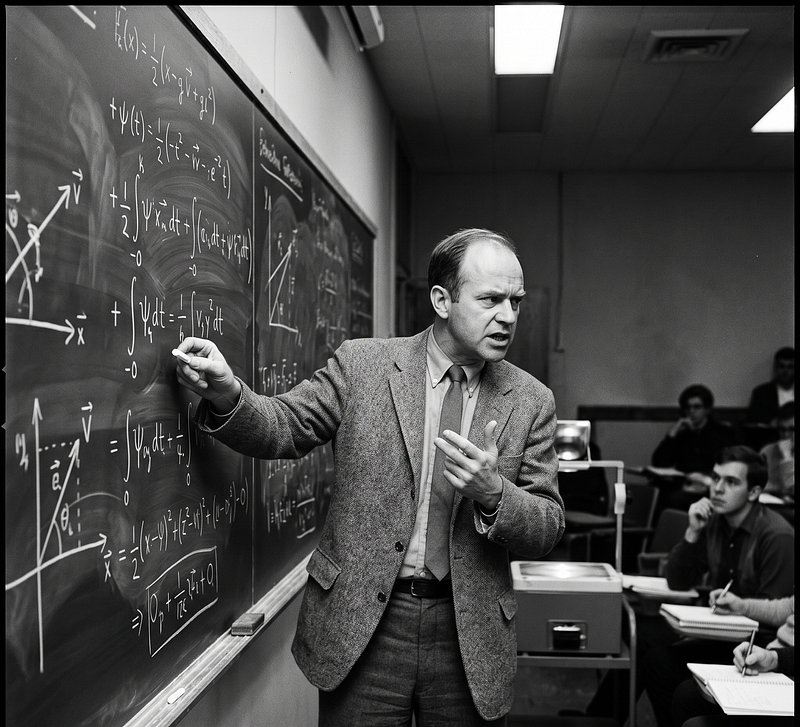
Cognitive science has a name for the opposite mechanism: the generation effect. A study published in the Proceedings of the National Academy of Sciences on university courses showed that students in active learning, those who produce, solve, generate, get better results than those in passive lectures. The paradox: students in lectures feel better trained. They rate their own learning higher. And they perform worse on independent tests.
The illusion of competence is inversely proportional to the effort of production.
AI is the most sophisticated machine for manufacturing illusions of competence ever built.
The degrees of production
I have been coding LLM agents for a few months — mainly in VS Code, with assistance tools like GitHub Copilot. My understanding of code has improved. Really. I understand concepts I didn’t know, I spot errors I didn’t use to see, I can read an architecture I would have been unable to interpret a year ago.
But this understanding is bounded. Precisely bounded by what I have actually done.
I haven’t mastered what lies underneath. I am not able to write a clean function without assistance. Because I have mostly prompted, given instructions, corrected outputs, validated results, without ever having to build the logic myself, line by line, with the mistakes that come with it.
There are degrees of production. Prompting an agent to generate code is producing something — but it is not coding. Having AI draft a text and editing it is producing — but it is not writing. The understanding you develop is exactly proportional to the share of cognitive work you refused to delegate.
AI excels at erasing technical friction. That is precisely what makes it problematic for real learning: you can produce something with it without ever having to think things through to the end.
The final paradox
The barrier to production has objectively come down. Tools are cheaper, more accessible, more powerful. Anyone today can build an agent, publish an article, put together an analysis that would have taken weeks five years ago.
And yet the number of real producers has not grown proportionally.
Because the barrier was not technical. It never was. The real barrier is psychological friction: the moment when you don’t know how to go on, when you get stuck, when you fail and have to start over without a safety net. It is that friction, uncomfortable, invisible, stubborn, that produces real understanding.
AI removes the technical obstacles. It doesn’t touch the psychological obstacle. And because it makes passivity more stimulating, more interactive, more like engagement, it paradoxically makes the leap to production harder, not easier.
The gap between those who really build and those who ask questions can’t be seen from the outside. Both “use AI”. Both spend time on it. Both feel like they are making progress.
It is not the same gap.
What you produced with it
The democratization of access to knowledge is real. It is precious. In dozens of contexts (education, health, research), it changes lives, and deserves to be defended without ambiguity.
It does not exempt anyone from the opposite approach.
Understanding has a fixed cost that has not moved: building something with what you think you know. Coding something, even clumsily. Writing a text, even an imperfect one. Making a decision on unfamiliar ground and living with the consequences. This is not a romantic stance on effort. It is the mechanism that has not changed — and will not change, no matter what access costs.
The real question the AI revolution raises is not “do you have access?”
It never was.
The real question is: what have you produced with it?